What the movement is for
At its simplest, Scouting and Guiding exist to help young people become confident, capable and kind. The outdoors is the classroom, but the real lesson is character: learning to make decisions, to look after others and to keep going when the tent pole snaps in the rain. Robert Baden-Powell, who started Scouting after a trial camp in 1907, called it "a game with a purpose". That phrase is still a good compass point.
The two worldwide umbrella bodies are the World Organization of the Scout Movement (WOSM) and the World Association of Girl Guides and Girl Scouts (WAGGGS). Each country has its own national organisation that belongs to one or both. In the UK that means The Scout Association and Girlguiding; in the United States, Scouting America and Girl Scouts of the USA. You will never need to deal with the world bodies directly, but it helps to know they are there.
Signpost: Scouts or Guides?
Both come from the same root. Guiding is led by and for girls and women. Scouting, in the UK and many other countries, is open to everyone regardless of gender. Neither is "better"; they simply offer different settings.
The age sections, step by step
Young people move through sections as they grow, each with its own name, uniform colour and style of activity. Names differ by country, so here is the UK pattern as an example:
| The Scout Association | Ages | Girlguiding | Ages |
|---|---|---|---|
| Squirrels | 4–6 | Rainbows | 4–7 |
| Beavers | 6–8 | Brownies | 7–10 |
| Cubs | 8–10½ | Guides | 10–14 |
| Scouts | 10½–14 | Rangers | 14–18 |
| Explorers | 14–18 | Young leaders & adult members | 18+ |
| Network | 18–25 | — | — |
Younger sections focus on play, games and first experiences away from home. Older sections take on more independence: planning their own expeditions, running events and, eventually, helping lead younger children.
Who runs a local group
Almost every local group is run by volunteers. A group usually has a lead volunteer (titles vary), section leaders for each age range, assistants, and a small committee or trustee board that handles money, the building and insurance. Above the group sit districts and counties or regions, which organise training, larger camps and support.
This matters for newcomers because it explains a lot. Waiting lists exist mainly because there are not enough adults, not because the group is exclusive. Meeting times move when a leader changes jobs. And a parent who offers a single evening a month can make a real difference to how many children get a place.
What a typical week looks like
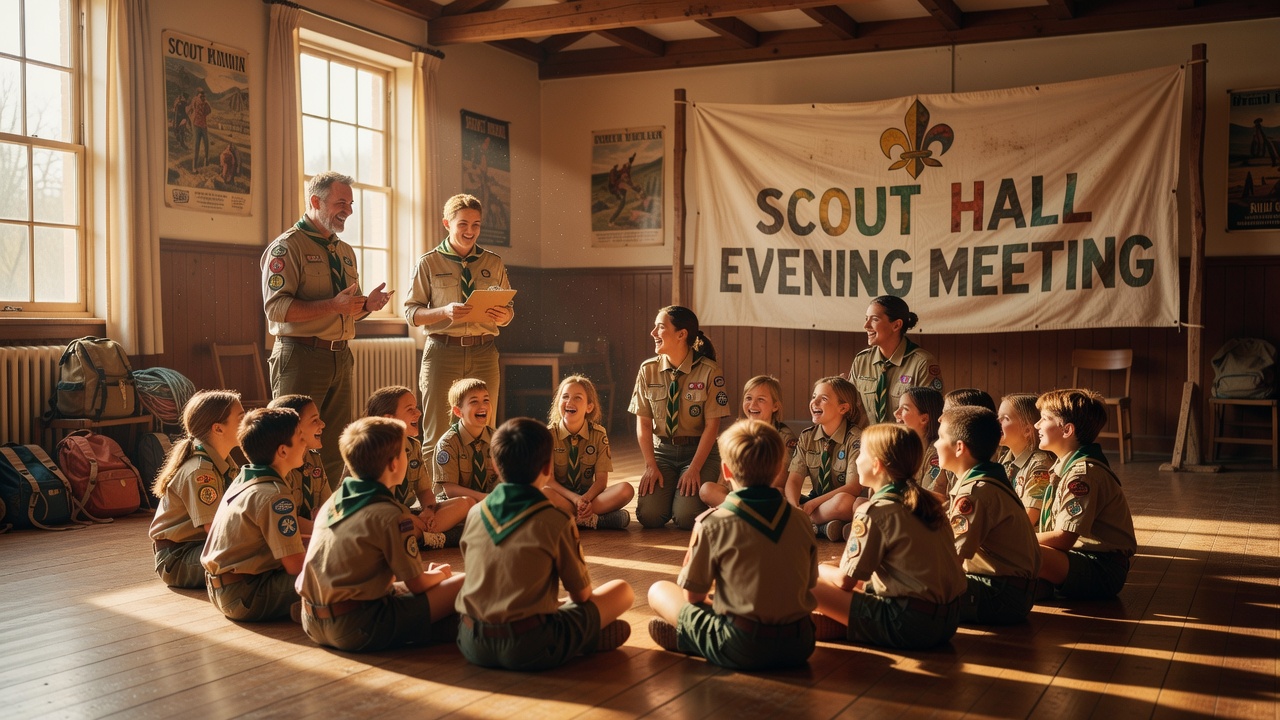
Most sections meet once a week for between one and two hours, often in a dedicated hut, a church hall or a school. A meeting might open with a short ceremony, move into a game, then into an activity tied to a badge: cooking on a camping stove, learning first aid, planning a hike. Summer evenings are frequently spent outdoors. Every few months there are bigger moments such as a sleepover, a weekend camp or a community project.
What you know now
The movement aims to build character through adventure; it is organised in age sections; and local groups depend on volunteers. With that in your pocket, Route Two explains how the activities themselves are designed.